Der, die, das
German has three genders: der Tisch, die Tür, das Fenster. Learn every noun with its article, because the article changes the endings around it.
 German course · 27 languages in one app
German rewards the people who just start talking. Talvo writes your lessons around what you care about (one learner's first unit was set in a chess club) and gives you a tutor to practice with until the word order feels normal.
First lesson free · iPhone and Mac, one subscription
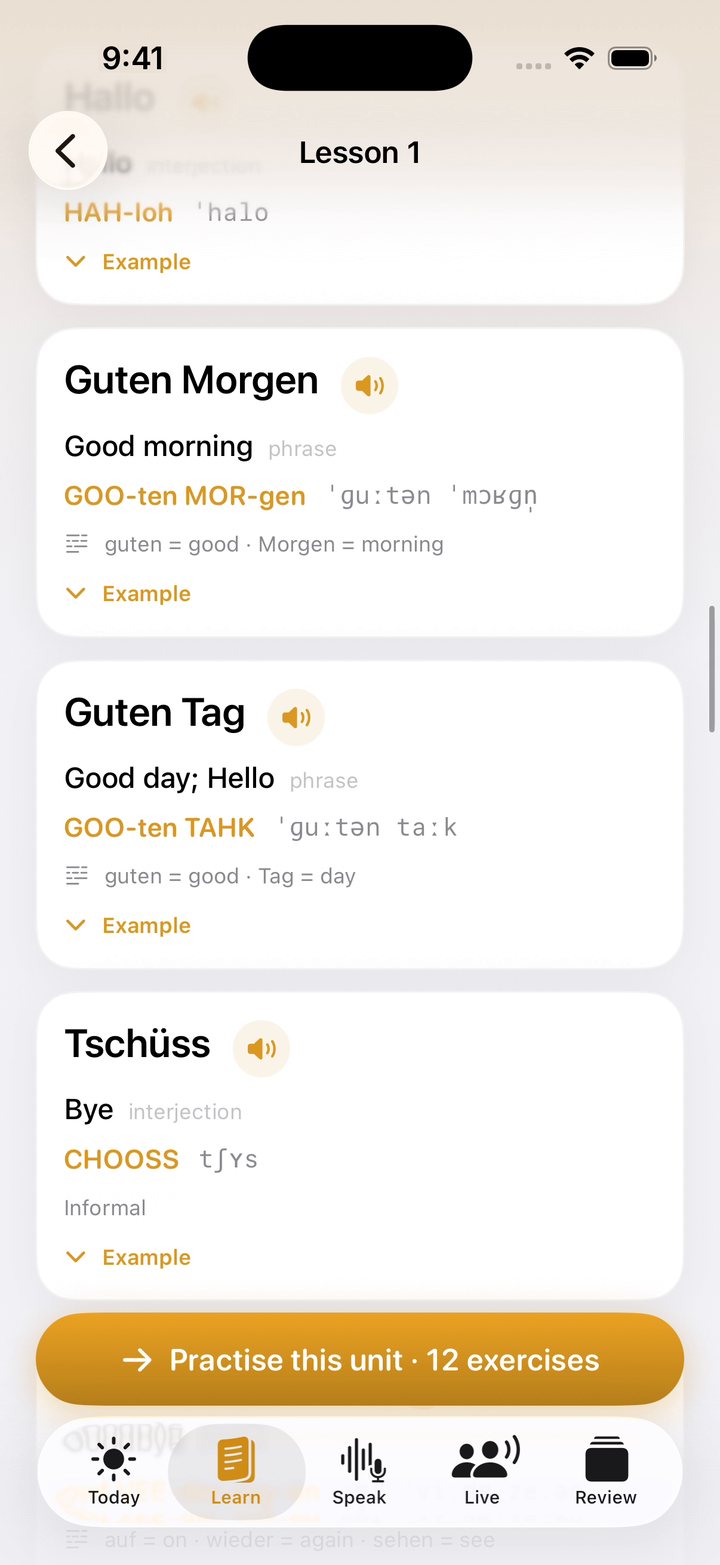
Twelve phrases for your first week, with the same pronunciation guide you'll see in the app.
| German | Say it like | Meaning |
|---|---|---|
| Hallo! / Guten Tag! | HAH-loh / GOO-ten TAHK | Hello / Good day |
| Wie geht's? | vee GAYTS | How are you? |
| Ich heiße Sam. | ikh HY-suh sam | My name is Sam. |
| Freut mich! | FROYT mikh | Nice to meet you! |
| Ich hätte gern einen Kaffee. | ikh HET-uh gehrn EYE-nen KAF-ay | I'd like a coffee. |
| Was kostet das? | vahs KOS-tet dahs | How much is it? |
| Die Rechnung, bitte. | dee REKH-noong, BIT-uh | The check, please. |
| Wo ist die Toilette? | voh ist dee toy-LET-uh | Where is the restroom? |
| Ich verstehe das nicht. | ikh fehr-SHTAY-uh dahs nikht | I don't understand. |
| Sprechen Sie Englisch? | SHPREKH-en zee ENG-lish | Do you speak English? |
| Entschuldigung! | ent-SHOOL-dee-goong | Excuse me / Sorry |
| Danke schön! Tschüss! | DAHN-kuh shurn! CHOOSS | Thanks a lot! Bye! |
The kh in this guide is the soft German ch, a breathy sound like the h in huge said with more air.
Talvo's lessons follow your interests. If you're into chess, your first German conversation might happen at a chess club.
German has three genders: der Tisch, die Tür, das Fenster. Learn every noun with its article, because the article changes the endings around it.
In a normal sentence the verb sits in second place: Heute spiele ich Schach, not “Heute ich spiele Schach”. Talvo corrects the order and explains the rule.
Use Sie (always with a capital S) with strangers and at work, and du with friends, family and kids. Verb forms change with it: Wie heißt du? or Wie heißen Sie?
After e or i it's soft, as in ich. After a, o or u it comes from the throat, like the ch in Scottish loch, as in acht.
Talvo teaches standard German (Hochdeutsch), which is understood in Germany, Austria and Switzerland.
Yes, to start. Your first lesson, three live-interpreter exchanges, your reviews and your deck are free. Talvo Pro unlocks unlimited lessons and conversations, and the yearly plan starts with a 7-day free trial.
Duolingo is built around short tap-and-match exercises and daily streaks. Talvo is built around speaking: lessons written around your interests, a tutor you talk to out loud, and a live interpreter for real conversations. Plenty of learners use both.
Yes. Talvo is a native app for iPhone and Mac, and one subscription covers both.
The first lesson is free. It takes about five minutes.


