Un or una
Every noun is masculine or feminine, and the article has to match: un café, una cerveza, un croissant. Say “una croissant” and Talvo corrects it and tells you why.
 Spanish course · 27 languages in one app
Most apps teach you to tap the right word. Talvo makes you say it: order a coffee in Mexico City, ask for directions in Madrid, and get corrected the way a patient friend would, quietly and with the reason.
First lesson free · iPhone and Mac, one subscription
Twelve phrases you'll use in your first week, with a simple guide to how they sound in Latin America.
| Spanish | Say it like | Meaning |
|---|---|---|
| Hola, ¿cómo estás? | OH-lah, KOH-moh ehs-TAHS | Hi, how are you? |
| Mucho gusto. | MOO-choh GOOS-toh | Nice to meet you. |
| Me llamo Sam. | meh YAH-moh sam | My name is Sam. |
| Quiero un café con leche. | KYEH-roh oon kah-FEH kohn LEH-cheh | I'd like a coffee with milk. |
| ¿Cuánto cuesta? | KWAHN-toh KWEHS-tah | How much is it? |
| La cuenta, por favor. | lah KWEHN-tah, pohr fah-VOHR | The check, please. |
| ¿Dónde está el baño? | DOHN-deh ehs-TAH ehl BAH-nyoh | Where's the bathroom? |
| No entiendo. | noh ehn-TYEHN-doh | I don't understand. |
| ¿Puede hablar más despacio? | PWEH-deh ah-BLAHR mahs dehs-PAH-syoh | Can you speak more slowly? |
| Disculpe. | dees-KOOL-peh | Excuse me. |
| ¡Qué rico! | keh REE-koh | So good!About food, mostly in Latin America |
| Muchas gracias. | MOO-chahs GRAH-syahs | Thank you very much. |
In Spain, c before e or i and the letter z sound like the th in think, so gracias sounds like GRAH-thyahs.
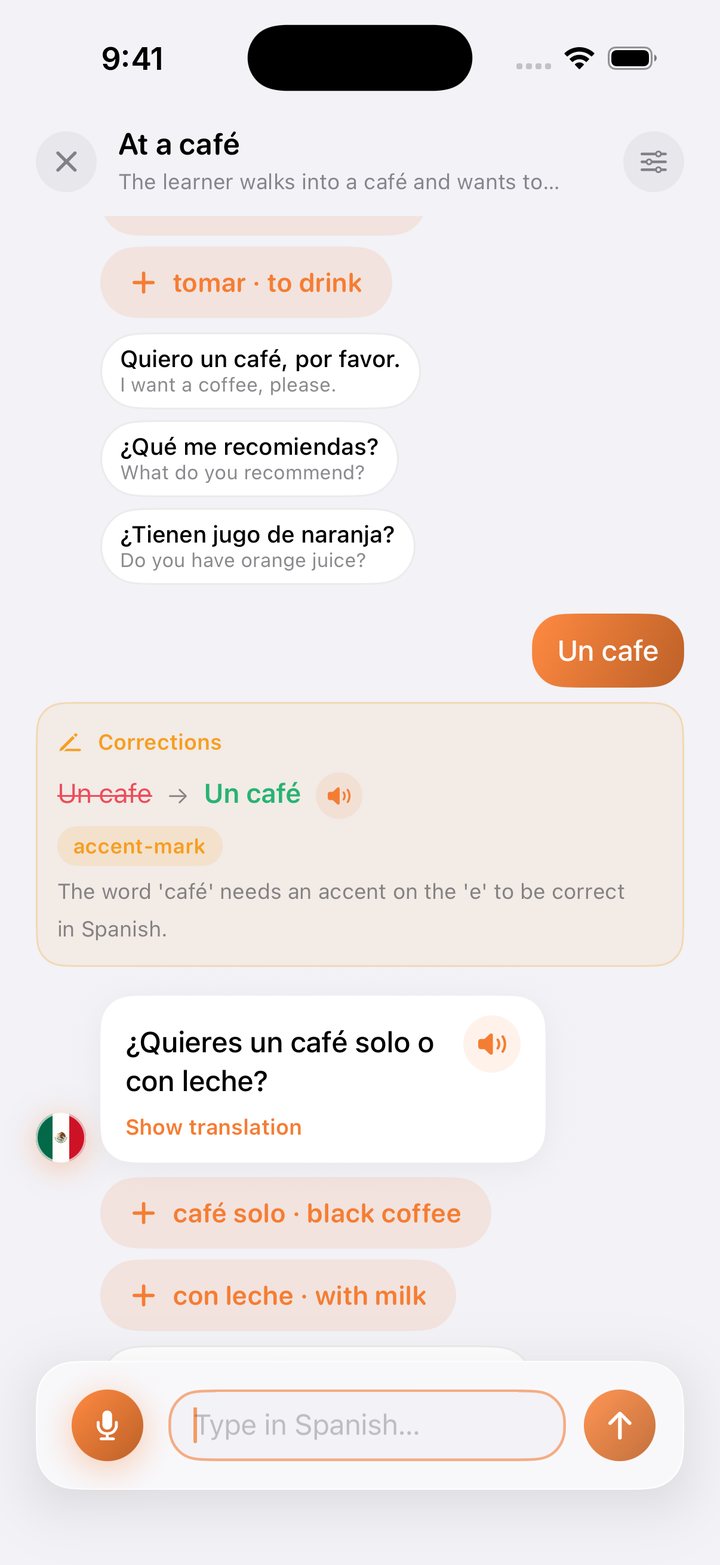
This is how a café scene goes in Talvo. The tutor plays the barista, you answer out loud, and mistakes get fixed as you go.
Every noun is masculine or feminine, and the article has to match: un café, una cerveza, un croissant. Say “una croissant” and Talvo corrects it and tells you why.
Sí means yes and si means if. Papá is dad and papa is potato. A missing accent gets a nudge, not a fail: un cafe → un café.
Both mean “to be”. Use ser for what something is (soy de Texas) and estar for how or where it is (estoy cansado, estoy en casa).
Tú is for friends. Usted is for strangers and older people, and in Mexico you'll hear it in shops and taxis. Talvo's scenarios use whichever a real person would.
Both. Spanish (Mexico) and Spanish (Spain) are separate courses, so vocabulary, pronunciation and voices match where you're going.
Yes, to start. Your first lesson, three live-interpreter exchanges, your reviews and your deck are free. Talvo Pro unlocks unlimited lessons and conversations, and the yearly plan starts with a 7-day free trial.
Duolingo is built around short tap-and-match exercises and daily streaks. Talvo is built around speaking: lessons written around your interests, a tutor you talk to out loud, and a live interpreter for real conversations. Plenty of learners use both.
Yes. Talvo is a native app for iPhone and Mac, and one subscription covers both.
The first lesson is free. It takes about five minutes.


